Showing posts with label Akira. Show all posts

Wednesday, 4 May 2011

Graphic: My favourite comics/manga

Disclaimer: These graphic novels are intended to be read by young adults and older. As they contain mature themes and imagery, I would not recommend them to anyone under the age of sixteen.
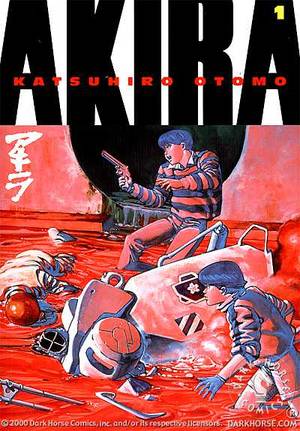
Akira - Katsuhiro Otomo

Epic doesn't really do justice to the six thick volumes that make up this Japanese classic. Set in the post-apocalyptic city of Neo-Tokyo, the series follows the adventures of juvenile delinquents Kaneda and Tetsuo, members of a biker gang who stumble upon a secret government programme involving individuals gifted with terrible psychic powers. After an encounter with Takeshi, a member of the government experiement, Tetsuo's psychic potential is unharnessed, transforming him into a power-hungry maniac with the goal of reawakening Akira - the source of the explosion that destroyed Tokyo thirty years earlier. The only person who can stop him is Kaneda. Headstrong and cocky, Kaneda has always made Tetsuo feel inferior, which drives him to strive even harder for more and more power.

Akira has everything a great graphic needs. Amazing artwork, some of which is so detailed it could be lifted straight from a technical illustration in some complex machinery blueprint. A vast array of colourful characters populate the world of the story, from the world-weary and resilient Colonel Shikishima to the enigmatic young terrorist Kei, also Kaneda's love interest. The plot mixes the grand themes of political intrigue and natural/man-made disaster with simpler tales of friendship, rivalry and loneliness. As well as being a very serious series, carrying heavy messages about Japan's experiences of nuclear war and natural disasters, Akira has many humourous asides, providing an effective contrast with the serious subject matter and sometimes dense scientific jargon. All in all, probably the best graphic novel I've ever had the pleasure of reading.

Watchmen - Alan Moore and Dave Gibbons

Still on the subject of nuclear war, but this time across the pond in the United States of America, Watchmen is set in an alternative 1980s, where the existence of superheroes has changed the course of history. America has won the Vietnam War with the help of the seemingly omnipotent 'Dr Manhattan', but as a result the Cold War has escalated to brink of nuclear disaster. The once-loved 'masked heroes' have been forced underground, vilified as common vigilantes. However, the death of Edward Blake, aka costumed crime fighter 'The Comedian', leads his one-time allies to uncover a sinister plot with far-reaching consequences.

Watchmen is similar to Akira in that the novel has a massive scope, its narrative stretching far beyond the realms of a simple superhero story. The structure of the book is interspersed with faux novel entries, news articles and psych profiles, as well as a metafictional 'comic-within-a-comic', 'Tales of the Black Freighter'. Although these elements may initially confuse the reader, may wish to skip on to the next scene in the main story, they serve to flesh out the main narrative, drawing you further and further into the world of the Watchmen. There are some great original characters to enjoy here, such as the unhinged and brutal 'Rorschach', whose ink-blot mask as become an iconic symbol, along with the 'smiley' pin flecked with a drop of blood. Although the story of Watchmen is one that covers world-altering events, it doesn't ignore the importance of the minute human interactions that shape the planet as dramatically as the power of nuclear bombs. Love, friendship, isolation and morality all play a part in this story, making it a serious tale with interesting lessons to impart.

Scott Pilgrim - Bryan Lee O'Malley

Time for something a little less serious. But then again, what could be more serious than winning the heart of the most amazing girl in the world? Even if you have to defeat her seven evil ex's in deadly hand-to-hand combat? This is the challenge that Scott Pilgrim, 23 year-old Canadian loser/martial arts genius, must complete to ensure that the enigmatic and beautiful Ramona Flowers will be his girlfriend. Scott also has his plate full with trying to find and hold down a job, dealing with his vengeful former loves, and playing some awesome bass riffs in grunge/rock band 'Sex Bob-omb'.

As I said earlier, Scott Pilgrim doesn't exactly tackle the big issues raised by Akira and Watchmen, but this doesn't make it any less enjoyable. This comic takes an interesting post-modern approach to story-telling, never really addressing whether Scott's fantastical battles are a figment of his imagination, an allegory/metaphor for his internal emotional struggles, or just actually happening. My guess is that all three are true. In terms of artwork, this comic once again takes a simplistic approach, but in a really lovable and clever way. O'Malley's characters and backgrounds may invoke an 'I could do that' reaction in some, but I'm sure this isn't true in most cases. The real stars of Scott Pilgrim are the characters, who embody all the comedy, confusion and desire that life has to offer - whilst kicking ass across a variety of dimensions. 

Cowboy Bebop - Hajime Yatate and Yutaka Nanten/Cain Kuga

As we return to Japan again, we take a giant step into a future where hyperspace travel has led to humanity colonising the far reaches of the galaxy, with crime springing up at every turn. Step in the crew members of the spaceship Bebop, a group of down-on-their-luck bounty hunters seeking to scratch a living from searching out the criminals the authorities are too busy to apprehend. Led by the distant and carefree former syndicate member Spike Spiegel, the hunters bumble their way through each assignment, mixing danger and comedy in fairly equal measures, making many enemies but also finding a few allies. Jet, a gruff former police officer, Faye, a luscious femme-fatale with an addictive streak, and Ed, an androgynous and youthful computer hacker, make up the crew, each adding another element of madness to this intergalactic journey.

Unlike the previous three entries, the Cowboy Bebop series only has a loose main narrative throughout, with each story working in isolation as well as part of an overall collection. The artwork in both sections of the five books has a fantastic manga sci-fi look, feeling simultaneously recognisable and original. In particular, the character of Spike has a great design, with his epically large hair and trademark scruffy suit, incomplete without the obligatory firearm. Like Scott Pilgrim, this series shies away from the heavy issues, opting for action and laughs - both of which it does well. However, their is an undeniable noir feel to this comic, hinting at the more serious and dark motivating forces beneath the characters' bright and flashy exteriors.

Batman: The Killing Joke - Alan Moore and Brian Bolland

Everyone knows the origins of The Dark Knight, how young Bruce Wayne watched his parents gunned down in front of him, that moment defining him as the iconic caped crusader of Gotham City. But what about his purple-suited grinning nemesis? How did he become the crazed master criminal that taunts Batman at every turn? This novel offers one version of the events in The Joker's backstory that twisted his mind as well as his features. In contrast to this tale from the past, Batman must embark on a new diabolical mission; to save Commissioner Gordon from The Joker's clutches, facing a deadly labyrinth of challenges all designed to break Wayne's sanity, with the aim of reducing him to the level of his mischievous and amoral enemy.

Another contrast to place alongside the previous graphic novels and series, this story is only one short story in the Batman canon. The reason I wanted to read this story in particular was that it was cited as one of the influences for Christopher Nolan's The Dark Knight. Anything that helped produce the best Batman movie, possibly the best superhero movie, is definitely worth a read. This story is very dark, delving into The Joker's twisted mind. The artwork follows the classic Batman palette, with The Dark Knight in grey and black and The Joker in his vibrant purple suit and shocking green hair, which gives the book a timeless feel. Probably the biggest achievement of this story is to show that superhero narratives and comic books can deal with deep and heavy issues, commenting on sociopathic behaviour as apposed with societies norms and values.

Thursday, 27 January 2011

Beyond Thought - Short Story

Image from humansfuture.org
It was a dull wispy morning, the gantries of Neo London draped with fog. The towering angular structures grew out of the misty depths below and disappeared into the clouds above. Kale scuffed her way along the suspended pathway, fiddling with her burgundy blazer, her short brown hair still wet from her hasty shower. Although the gantries were full of people on their way to work or school, she walked alone, like every morning. Her younger brother and sister would dart off in a different direction once the children had left the apartment building. They didn't want to be seen with their reject sibling, their leprous relative.

Kale stood patiently at the crossing bridge, waiting for the air traffic to divert and the platforms to link. She didn't want to arrive at school any quicker than she needed to. She noticed a business man in a formal grey suit also waiting at the crossing. He stood as far away from the girl as he possibly could, pretending she wasn't there and yet simultaneously very aware of her presence. As the platforms hovered together and bridged the immeasurable drop with a magnetic click, he strode away as quickly as he could. She could tell he was afraid, repulsed by her emptiness. You didn't need to be a psychic to work that out.

. . .

How are you progressing with the task, Kale?” 

Miss Warner smiled as she made the enquiry, but that only made her appear more patronising.

Um...OK I guess.” 

Kale turned her work book around for the youthful blonde teacher to see. The young girl was one of the two children seated in the non-psi area at the back of the classroom. The 'normal' children sometimes got spooked by the 'dead-heads' as they were known. The empty psychic space where thoughts and feelings should flow made them nervous, especially the chipped kids, afraid their implants would break if they got too close, sending them back into the mental darkness that Kale experienced daily. She didn't know why she and the others whose minds had rejected the chip didn't just work in different rooms, or go to a different school altogether. Probably because that would be too much like segregation, and this, well, this was nothing like segregation at all.

I have identified some mistakes,” said Miss Warner, overly formal. The spoken language that teachers like her had to learn was so rigid, so lifeless and cold. “I have marked them with a circle. Please try to identify and rectify the errors.”

Kale nodded. Miss Warner turned and walked back to the front of the class, soundlessly communicating with the psychic majority. Kale could tell when they were talking psychically. The movement of their eyes, the turn of their heads, lots of little clues they probably thought she didn't notice.

Sitting a couple of desks away from Kale was Derek Middler, a spotty little boy, the only other non-psi student in the classroom. Despite their shared affliction, she always kept her distance from the scowling youth. He was a troubled, volatile child, like many non-psi children could be, feeling paranoid and threatened. Not someone you wanted to be associated with.

They're talking about us,” Middler muttered.

Heads turned. Kale wished she could sink through the floor with embarrassment. Why did she always get put with the crazy ones?

You got something to say?” Derek challenged. He jumped up from his seat aggressively. Some of the students shrank back. Others grinned mockingly.

Don't laugh at me!”

Please calm down, Derek,” said Miss Warner evenly.

She'll be summoning the hall attendants now, thought Kale. Derek wasn't going to calm down.

Shut up!” 

The wiry boy pushed his desk over, his books and pens clattering to the ground. Two hall attendants entered the room. They walked straight up to Derek, faces emotionless, and grabbed the boy, who struggled against them, yelling and screaming. They dragged him out of the room, his rage echoing away down the corridor.

Kale looked down at her book, her face flushed with shame, knowing that all the remaining occupants of the room were scrutinising her. If not with their eyes, then with their minds.

When are you going to snap? they questioned.

When are you going lose it?

. . .

The family sat around the table, plates of hearty home-cooked food in front of each member. Kale ate slowly, chewing each mouthful with a deliberately sluggish pace. They might not try to converse with her if they think her mouth is full. She assumed her mother, father and siblings were talking together; her mother hadn't awkwardly broken the silence for a few minutes.

Molly was just saying she might apply for kinetics next semester,” said Kale's mother out of the blue.

“Oh, OK,” replied Kale, thinking about how fun it would be avoid the objects her younger sister would send flying at her with the power of her mind. Her mother often did this, tried to act as interpretor; a guilty attempt to make her other child feel included. She only saw pity when she looked into her mother's eyes, a pity that outweighed love.

“Your father is taking the day off on Friday. We are all going to the holo-pool together.”

That sounds cool,” the young girl replied unconvincingly. Her mother frowned.

I think they have adequate heating.”

No, I mean...forget it.” None of them were used to speaking, they'd lost the natural ability. Kale had learnt from old films and songs, conversing with herself, re-enacting scenes, playing all the characters.

Molly laughed. Kale knew this was aimed at her. Whenever her brother or sister poked fun at her, they always laughed out loud so she would know they were laughing at her. Their father gave them a stern look. Kale ignored them. She had risen to their baiting in the past, responding to their hollow chuckles with white hot anger. Over time, however, she had learnt to block it out.

. . .

“Goodnight Kale.” Her mother turned out the light. She didn't kiss her daughter at bedtime anymore. She didn't need to with her other children, they could feel her love in their minds. She had forgotten, trying so hard to stop Kale from feeling different. As the young girl rolled over under the covers she longed for her mother's touch, those soft arms encircling her in a simple hug. She began to cry, sobbing as quietly as she could. The loneliness didn't always sting this badly, but some days she couldn't help but feel crushed under the weight of the isolation, feeling like the only person who hadn't been told a secret. She reached over to her bedside table and removed her ear pieces, slotting them in comfortably. 
Ray Charles, 'I Can't Stop Loving You'.

The voices surrounded her, soothing her. She imagined she was part of the ensemble, singing the refrain in perfect harmony.

To be a part of something.

That was all she desired.

Friday, 19 November 2010

Adapting books to the screen: a brief consideration

With the seventh installment in the Harry Potter film saga being released in the cinema this week, the subject of 'book-to-film' adaptations has been on my mind. It's a topic that is very easily seen in polemic terms, with one camp stating that the book is always superior to the film, and those at the other end of the spectrum saying the exact opposite. However, I think a little more consideration needs to be taken before any judgements can be made.


It is short-sighted to judge the film adaption of a novel by the same criteria as the original text. I get really annoyed when I hear a movie being criticised for 'leaving out' parts of the book; if a literal adaptation of a novel was ever attempted, it would be an extremely tedious and dull experience for the viewer, not to mention the longest film ever made. The director's job when making a screen version of a written work is to put across the essence of the story, using the elements of the book that are most relevant to the visual medium. With some books this task is quite simple. For example, Cormac McCarthy's novels read very much like screenplays and embody a cinematic tone, meaning that the film adaptations of No Country For Old Men (2007) and The Road (2009) easily retain the qualities that made the books so enjoyable. With longer fantasy-based novel's like Harry Potter, the director's retelling has to be much more subjective.


This leads me onto my next point: the role of a film adaptation isn't to provide a carbon copy of the original. Like it or not, but the director has a duty to present their own interpretation of the story, not just regurgitate the author's views and sentiments. When Katsuhiro Otomo adapted his own manga classic Akira (1988) to the screen, he made drastic alterations to the narrative, presenting the version of his story that works best for film. I will admit that I haven't always agreed with the choices a director/screenwriter has made during the adaptive process, but I'll defend to the death their right to make those choices. In a way, the activity of adapting a novel to the screen is just a continuation of the tradition of oral storytelling. As the narrative is passed on by one teller to the next, it is warped and contorted, gradually leaving behind many of the elements that made up its original form. In this case the director becomes just another link in the storytelling chain, passing on their version of the tale.

Don't get me wrong however; I'm not saying that cinematic retellings of novels should replace the original written document. Both are equally valid versions of the story, as long as they told with skill, imagination and integrity. Although I don't like people automatically attacking an adaptation movie, I also detest it when someone states that they won't read a book because they can just watch the film version. This attitude ignores the fact that all films start out as a written document; a screenplay. Without reading, and the imaginative processes it generates, there wouldn't be any films.

There is one situation where I do oppose the adaptation of books into films, and that is when 'Hollywood' gets involved. By this I mean, when studio execs look at a literature masterpiece and only see dollar signs. When this happens all the truth of a text is lost, replaced with the shallow goal of generating the biggest box office success. My example for this phenomenon would be I Am Legend (2007). Richard Matherson's original novel is a horror classic, chilling and inventive, with a really powerful if bleak conclusion. Director Francis Lawrence's adaptation removes almost all of the tension, replacing it with off-the-shelf jumps and scares, and reduces the vampires (yes, they are vampires, not weird zombie things) to unrealistic CGI ghouls. And the altered ending; don't get me started! Without wanting to spoil the story, the film's conclusion has no meaning at all, it says nothing new. But who cares when the film took $585 million worldwide? Isn't that what filmmaking is really about? I'm not so sure.

So in conclusion: not all novel-to-film adaptations are bad, in fact some books feel like they were written to be converted. I think I'm right in saying that Chuck Palahnuik actually acknowledged that he considers David Fincher's version of Fight Club (1999) to be superior to his novel. However, that doesn't mean that reading should now be obsolete; film cannot exist without the written word. I'll let you know what my assessment of the latest Potter adaptation in the not-too-distant future. In the meantime, keep reading AND watching!